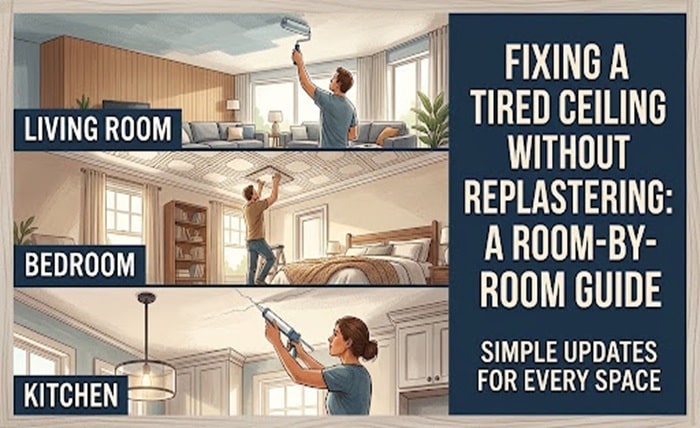
Ceilings age badly and quietly. Hairline cracks spread, artex sheds its texture, water stains bloom after a slow leak, and the whole room starts to feel dated without anyone being able to say exactly why. Replastering is the obvious answer, but it’s disruptive, dusty, expensive and takes days to dry before you can even think about decorating. There are faster routes that hold up well, provided you match the method to the room and the damage.
Before choosing anything, find out what’s actually wrong. A stain means water, and water means a leak that needs fixing first. Cracks that follow a straight line usually mark plasterboard joints where the scrim tape has failed. Cracks that run in random directions across an old lath-and-plaster ceiling often mean the plaster has lost its key and is pulling away from the laths overhead. Press gently — if an area flexes or sounds hollow, cladding over it won’t help and the loose section needs dealing with properly. Suspended or drop ceilings, common in commercial spaces and older conversions, are a different case again; there, damaged ceiling tiles can usually be lifted out and swapped individually without touching the grid.
Kitchens
Kitchen ceilings take the worst of it: grease, steam, and temperature swings that make paint peel around extractors and over hobs. Sugar soap and a proper degreaser will lift more than people expect, and a stain-blocking primer under a moisture-resistant satin or eggshell finish stops discolouration bleeding back through. If the surface is too far gone to paint, PVC or vinyl-faced panels are the pragmatic choice — they wipe clean, don’t absorb steam, and can be fitted over battens without stripping anything back. Improving ventilation matters just as much as the surface itself; without it, the same problem returns within a couple of years.
Bathrooms
Condensation is the enemy here. Mould on a bathroom ceiling is a symptom, not the fault. Treat the growth, then address extraction — a fan rated for the room volume, running on an overrun timer, does more good than any coating. For the surface, moisture-resistant panels with tongue-and-groove joints are widely used because they seal against vapour rather than absorbing it. Whatever goes up, leave a small expansion gap at the perimeter and cover it with trim; materials move with humidity, and a rigid fit will buckle.
Living Rooms and Bedrooms
These rooms are usually about appearance rather than moisture. Artex is the common headache, and if the property predates the 2000s it may contain asbestos — sanding it is genuinely dangerous, so have it tested before touching it. Overboarding with 9.5mm plasterboard screwed into the joists is a clean solution that leaves a flat surface ready for a skim or paint, and it buries the texture without disturbing it. Alternatively, decorative panels or planked cladding add character while hiding imperfections entirely. Both options lose 10–25mm of head height, which matters in rooms already under 2.3 metres.
Hallways and Landings
Narrow spaces show every flaw because light rakes across the surface at an angle. Filling, sanding and repainting in a matt finish is often enough — matt scatters light and disguises unevenness in a way that silk simply won’t.
A Note on Access
Whatever you choose, plan around what sits above. Downlights, cabling, loft hatches and pipework all need to stay reachable. Systems that allow individual sections to be removed and replaced are worth the extra thought at the planning stage, particularly in rented or commercial property where maintenance access is a recurring need rather than a one-off.