Choosing furniture for your home can be exciting, but it can also come with a surprising amount of uncertainty. You may find the perfect sofa, dining table, shelving system or storage unit online, only to wonder whether it will actually work in your space.
This becomes even more important when you are ordering custom furniture.
With different sizes, colours, materials, finishes and configurations to consider, it is not always easy to picture the finished piece from a few product photographs. A design that looks beautiful on a screen may feel completely different once it is placed in your room.
Fortunately, today’s digital tools make it easier to explore furniture before making a final decision. With the right approach, you can get a much clearer idea of how a custom piece will look, fit and work in your home before you place the order.
Start With the Space You Have
Before choosing a design, take a good look at the room where the furniture will go.
Start by measuring the available space, including the width, length and height of the area. It is also worth measuring doorways, hallways and staircases if the furniture is particularly large.
These measurements can help you avoid one of the most common furniture-buying mistakes: choosing something that technically fits but overwhelms the room.
Think about the space around the furniture, too. A sofa may fit against a wall, for example, but you still need enough room to walk around it comfortably.
Creating a simple floor plan can also help you understand how much space a piece will actually occupy.
Consider How You Use the Room
The right furniture is not only about measurements. It should also suit the way you live.
A living room used mainly for relaxing may need a different arrangement from one that doubles as a home office or entertaining space. Similarly, a dining area used every day by a family may require a different table configuration from one designed primarily for occasional dinners.
Think about how many people normally use the room, what activities take place there and whether those needs could change in the future.
This is one of the advantages of custom and modular furniture. Instead of adapting your lifestyle around a fixed piece, you can look for a design that adapts to the way you use your home.
Gather Inspiration Before Choosing Your Design
Once you understand your space, start collecting ideas.
Pinterest boards, interior design websites, magazines and social media can all be useful sources of inspiration. Save rooms, furniture pieces, colours and materials that catch your attention.
You may notice that you keep returning to similar styles, whether that is warm wood, minimalist furniture, soft neutral colours or bold statement pieces.
Creating a visual reference can make the furniture selection process easier because you already have an idea of the overall look you want to achieve.
However, inspiration is only the starting point. The next challenge is figuring out whether the furniture you like will actually work in your own home.
Understand What You Can Customize
Custom furniture offers more flexibility than buying a standard piece, but it also means making more decisions.
Depending on the product, you may be able to choose:
- Dimensions and proportions
- Upholstery or fabric
- Colours
- Wood and other materials
- Finishes
- Individual components
- Layouts and configurations
This freedom is useful, but having more options can make the decision-making process more complicated.
A customer might know that they want a modular sofa, for example, but still need to decide how many sections it should have, which fabric to choose, what colour will work best and how the final configuration will fit into the room.
This is where visualization becomes particularly valuable.
Don’t Rely on Measurements Alone
Measurements can tell you whether furniture will fit, but they do not necessarily tell you whether it will look right.
A large sectional sofa might technically fit into a living room while making the space feel crowded. A dark finish may look attractive online but create a heavier appearance when combined with dark flooring and walls.
Proportion, colour and visual balance all matter.
This is why it helps to see the furniture as part of the room rather than as an isolated product.
See the Design Before You Commit
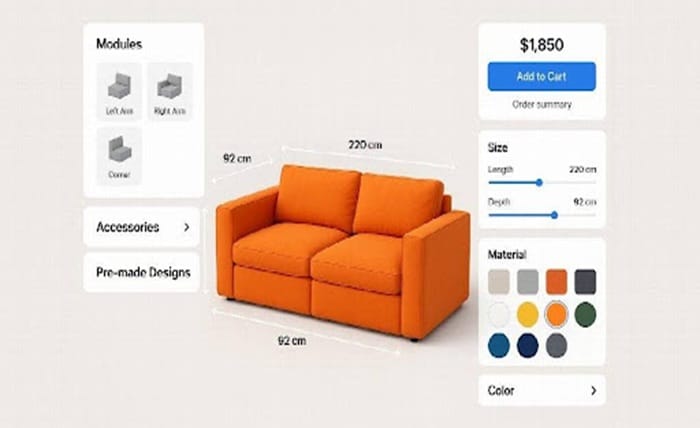
3D visualization can make this process much easier.
Instead of looking at a static photograph, you can explore a digital version of the furniture and see how different choices affect the final design.
Depending on the tool, you may be able to change colours, finishes, components or configurations and see those changes immediately.
This can be particularly helpful when buying custom furniture because you are not simply choosing a finished product. You are creating a combination of features that needs to work together.
Being able to explore those possibilities before ordering can make the decision feel much less like a guess.
Compare Different Options
One of the biggest benefits of digital visualization is the ability to compare.
Perhaps you are deciding between a light and dark fabric. Maybe you are unsure whether a smaller sofa or larger sectional will work better. You might also be considering different wood finishes or configurations.
Rather than trying to imagine each option separately, you can explore them side by side.
This can help you identify the option that works best with your existing furniture, flooring, walls and overall decorating style.
It can also prevent the disappointment of ordering a customised piece only to discover that one of your choices does not look quite the way you expected.
How 3D Technology Can Simplify Custom Furniture
For furniture brands, offering this type of experience requires more than simply adding photographs to an online store.
Businesses selling highly configurable products need to manage product options, combinations and pricing while giving customers a simple way to explore them.
This is where solutions such as Best 3d cpq software can become useful. By bringing product configuration, visualisation and pricing together, these tools can help furniture businesses give shoppers a clearer picture of what they are creating before they order.
For customers, the benefit is a more visual and interactive way to explore their choices. For furniture brands, it provides a way to present complex product ranges without overwhelming shoppers with endless menus and product variations.
The goal is not to add technology simply for the sake of it. It is to make a complicated decision easier to understand.
Look at the Furniture From Every Angle
When visualizing custom furniture, do not only consider how it looks from the front.
Look at the overall proportions and how the piece relates to the rest of the room.
Consider questions such as:
- Does it leave enough space to move around?
- Does the height work with nearby furniture?
- Do the colours complement the room?
- Does the configuration make sense for how the space is used?
- Will doors, drawers or other moving parts have enough room?
- Does the furniture look balanced from different viewpoints?
These details can be easy to overlook when making a decision from a single product photograph.
Think About How Your Home Might Change
Another useful consideration is whether the furniture will continue to work for you in the future.
Perhaps you are planning to move, create a home office or change the layout of the room. Maybe your household will grow or you expect your storage needs to change.
Flexible furniture can be useful in these situations because it can often be reconfigured or adapted rather than replaced entirely.
When exploring custom options, think beyond how the furniture will look today. Consider whether the design can continue to work as your needs change.
A Simple Checklist Before You Order
Before committing to a custom furniture purchase, take a few minutes to review your choices.
- Measure the room carefully.
- Check doorways and access points.
- Consider the furniture you already own.
- Think about how the room is used.
- Choose a style and colour direction.
- Compare different materials and finishes.
- Explore different configurations.
- Visualize the final design.
- Check the dimensions one more time.
- Review the final price before ordering.
Taking these steps can make the process much more straightforward.
Design With More Confidence
Custom furniture gives homeowners an opportunity to create pieces that feel much more personal to their space. But having more choice also means there is more to consider before placing an order.
Visualization can help bridge that gap.
Instead of relying entirely on imagination, shoppers can explore different designs, compare options and get a better understanding of how a finished piece could work within their home.
For furniture brands, the same technology can make complex products easier to present and customise online.
Ultimately, the best furniture choices are not necessarily the ones that look good in a catalogue. They are the ones that make sense for the space, complement the rest of the room and fit the way you actually live.
Being able to see those possibilities before you order can make the journey from inspiration to finished room a much more confident one.