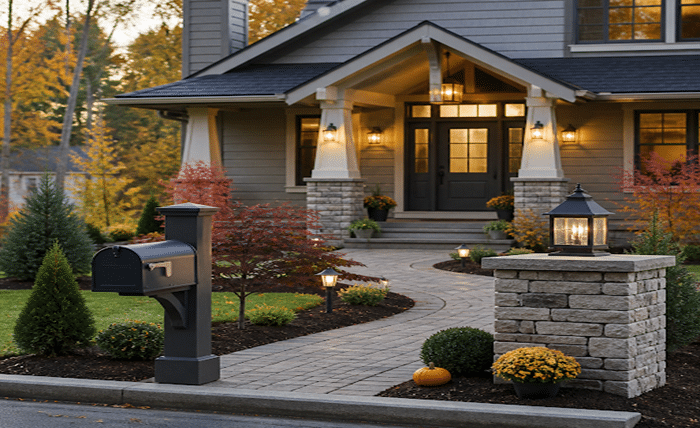
Your home’s exterior communicates something before a single word is spoken. The moment a visitor, delivery driver, or potential buyer pulls up to your property, they are already forming an opinion — and that opinion is shaped by details most homeowners overlook. House numbers, mailboxes, and seasonal decorations are not afterthoughts. They are the quiet language of a well-considered home, and when chosen with intention, they elevate everything around them. This article explores how to approach these exterior elements with the same care you would give to an interior renovation.
The Overlooked Power of House Numbers
It is easy to dismiss house numbers as purely functional — a way for the postal service and emergency responders to locate your address. But in practice, they serve a far more expressive role. The font, material, finish, size, and placement of your address numbers contribute meaningfully to the architectural character of your home. A sleek brushed-aluminum numeral mounted flush against a contemporary facade reads entirely differently than a wrought-iron serif number bolted to a Victorian porch column. Both are correct in their context. Neither is interchangeable.
The mistake most homeowners make is selecting numbers based solely on what is available at the nearest hardware store. This leads to mismatched finishes, awkward sizing, and numbers that feel like an afterthought rather than a design decision. The better approach is to treat your house numbers the way an architect treats a detail drawing — with specificity and purpose.
Sizing and Placement: Getting the Basics Right
Standard guidance suggests that house numbers should be visible from the street at a distance of at least 50 to 100 feet. This means that for most residential properties, numbers should be no smaller than four inches in height, and ideally five to six inches for homes set back from the road. Placement matters just as much as size. Numbers mounted beside a garage door, near a porch light, or on a gate post each create a different visual hierarchy. The goal is legibility without sacrificing elegance — a balance that requires thoughtful selection rather than a grab-and-go purchase.
Material and Finish: Matching Your Home’s Aesthetic
Brass, stainless steel, matte black powder coat, bronze, and acrylic are among the most popular materials for exterior house numbers today. Each carries its own maintenance profile and visual weight. Matte black has surged in popularity alongside the rise of modern farmhouse and minimalist architectural styles. Brushed nickel and satin brass work beautifully on transitional homes that blend traditional and contemporary elements. Whatever you choose, consistency with your door hardware, light fixtures, and mailbox finish creates a cohesive exterior palette that feels intentional rather than assembled by accident.
Mailboxes: A Functional Feature That Deserves Design Attention
The mailbox occupies a unique position in the landscape of curb appeal. It sits at the boundary between public and private space — often the first object a visitor encounters before reaching your front door. Despite this prominence, mailboxes are frequently selected with almost no design consideration. The result is a mismatch between a beautifully maintained home and a generic, rusting box on a splintered post.
Fortunately, the market for well-designed mailboxes has expanded considerably. From wall-mounted architectural units to post-mounted boxes with clean geometric profiles, there are options to suit nearly every home style and budget. For a deeper look at what design experts and editors consider the best mailboxes available today, Architectural Digest’s curated guide to top-rated mailboxes offers a well-researched starting point that covers both aesthetics and durability.
Coordinating Your Mailbox With Your House Numbers
One of the simplest ways to create a polished exterior is to coordinate your mailbox finish with your house number finish. If your address numbers are in matte black, a matte black mailbox — or one with matte black hardware — creates a visual thread that ties the entry sequence together. This kind of coordination does not require a large budget. It requires attention. When these two elements speak the same design language, the entire front of your home benefits from the coherence.
Seasonal Décor: Extending Your Home’s Personality to the Outdoors
Beyond the permanent fixtures of numbers and mailboxes, seasonal decoration offers a dynamic layer of expression. Holiday and seasonal displays allow homeowners to communicate warmth, creativity, and personality in ways that permanent architectural elements cannot. The challenge is doing so without overwhelming the underlying design of the home.
One of the most charming and increasingly popular seasonal approaches involves whimsical outdoor displays that transform a home’s exterior into something genuinely delightful. If you are looking for inspiration for the holiday season, this guide to whimsical outdoor gingerbread house decorations offers creative ideas that balance festivity with tasteful design — a combination that is harder to achieve than it looks.
Balancing Seasonal Displays With Permanent Fixtures
The key to successful seasonal decorating is ensuring that temporary displays complement rather than compete with your home’s permanent exterior features. Wreaths, garlands, and illuminated figures should be scaled appropriately to the architecture. A grand Victorian home can absorb more visual complexity than a minimalist modern structure. When in doubt, less is more — a single well-placed display often reads more powerfully than a cluttered arrangement that obscures the home’s natural character. Your house numbers and mailbox should remain visible and unobstructed even during peak decorating season.
Modern House Numbers: A Brand Built Around Exterior Excellence
For homeowners who take their exterior details seriously, finding a reliable source for high-quality address numbers is essential. Modern House Numbers has established itself as a go-to destination for design-conscious homeowners seeking address signage that goes beyond the generic. Their catalog spans a wide range of styles, materials, and finishes, making it possible to find numbers that genuinely suit a specific home rather than settling for whatever happens to be in stock locally. The brand’s focus on craftsmanship and aesthetic precision reflects an understanding that exterior details matter — and that homeowners deserve options that reflect that understanding.
Bringing It All Together: A Cohesive Exterior Strategy
Curb appeal is not a single decision. It is the cumulative result of many small decisions made consistently over time. Choosing the right house numbers, house address numbers, modern house numbers for your home’s architectural style is one of those decisions — and it is one that pays dividends every time someone approaches your front door. Pairing that choice with a well-selected mailbox and thoughtfully executed seasonal décor creates an exterior that feels complete, considered, and genuinely welcoming.
The homes that make the strongest impressions are rarely the most expensive or the most elaborately decorated. They are the ones where every visible element — from the address numerals to the mailbox post to the holiday wreath — feels like it belongs. That sense of belonging is not accidental. It is designed.
Conclusion
Exterior design is a discipline that rewards attention to detail. House numbers, mailboxes, and seasonal decorations each play a distinct role in shaping how your home is perceived — by guests, by neighbors, and by the community at large. Approaching these elements with the same intentionality you bring to interior design choices is not excessive. It is simply good design practice. Start with the details closest to your front door, work outward with consistency, and let your home’s exterior tell the story you actually want it to tell